




 STFCN - Silk Natural Taffeta Chinese














 Our textiles


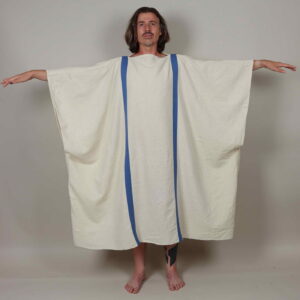


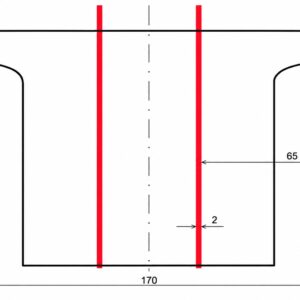


Clavi adorned Roman tunics for many centuries, but not all bands of this type looked or were made in the same way. Some of the earliest examples were woven directly into the structure of the fabric as it was being made. This required considerable weaving skill, as the decoration was not a separate element sewn onto a finished tunic, but an integral part of the fabric itself.
A closer look at the original tunics with clavi from the collections of the British Museum (photo on the right) clearly shows that the bands are part of the fabric itself.

This is exactly how we made our tunics with woven clavi. By analysing surviving archaeological finds, we recreated not only the characteristic appearance of the bands, but also the way they were originally woven.
The tunic itself is woven in a plain weave, while the clavi are created as weft bands in a 2/1 weft faced twill. This gives us clearly defined bands that stand out from the rest of the fabric, while avoiding the effect of a visible, light-coloured warp that would appear with a different construction.
It may seem like a small detail at first glance, but it is precisely these details that help bring a reconstruction closer to the original Roman textiles.
Tunics decorated with two clavi remained part of Roman fashion for many centuries. Their popularity grew significantly during the Republican period, when we also find the earliest examples of a form similar to ours – with two clavi woven directly into the structure of the fabric and made in different colours.
Over time, clavi became increasingly decorative. The bands began to be woven in a variety of patterns, and the practice of sewing them onto the finished tunic fabric also emerged.
If you would like to learn more about how clavi and the tunics they decorated changed over time, visit our blog, where you can find an article dedicated to the history of clavi tunics.
Yes, but much depended on the time, place, and type of clavi. The earliest use of clavi is indeed described in the sources as a distinguishing feature associated with particular social groups. The broad, purple latus clavus was associated with senatorial rank, while the narrow angustus clavus was associated with the equestrian order. Moreover, an emperor could grant the latus clavus to people outside the senatorial class, thereby giving them the opportunity to pursue a senatorial office.
Over time, tunics decorated with clavi became much more widespread and began to be worn by members of different social groups. The colour and type of dyes used could still say something about the wearer’s wealth and financial status. Different dyes varied in price and availability, so people with different financial means could afford different colour palettes and more or less expensive fabrics.
This does not mean, however, that a particular colour automatically indicated a specific social position. For example, an enslaved person could wear a tunic with more expensive, intensely dyed clavi if it had been provided or paid for by their master.
Therefore, when it comes to later tunics with clavi, the colour of the band should not be treated as a simple code for social status. The meaning of the decoration changed over time, while its appearance was influenced by fashion and custom as well as by the availability and cost of materials.
Clavi tunics were very loose and voluminous – surviving examples are often almost square in shape and can be up to 1.5 metres wide. These tunics, sewn together only at the shoulders and sides, were worn loosely draped and fastened with a belt.
Once the belt was tied, the excess fabric was pulled up over it, creating a characteristic pouch of gathered fabric around the waist and abdomen. The excess fabric at the shoulders, meanwhile, fell loosely, creating something resembling short sleeves.
We take a closer look at how clavi tunics were worn and explore different ways of draping them in an article on our blog.
